Tag Archives: Russia
Russia’s Wildfires Are Bigger Than All Other World Fires Combined
Russia’s ‘slow-motion Chernobyl’ at sea

By tradition, Russians always bring an odd number of flowers to a living person and an even number to a grave or memorial. But every other day, 83-year-old Raisa Lappa places three roses or gladiolas by the plaque to her son Sergei in their hometown Rubtsovsk, as if he hadn’t gone down with his submarine during an ill-fated towing operation in the Arctic Ocean in 2003.
“I have episodes where I’m not normal, I go crazy, and it seems that he’s alive, so I bring an odd number,” she says. “They should raise the boat, so we mothers could put our sons’ remains in the ground, and I could maybe have a little more peace.”
After 17 years of unfulfilled promises, she may finally get her wish, though not out of any concern for the bones of Captain Sergei Lappa and six of his crew. With a draft decree published in March, President Vladimir Putin set in motion an initiative to lift two Soviet nuclear submarines and four reactor compartments from the silty bottom, reducing the amount of radioactive material in the Arctic Ocean by 90%. First on the list is Lappa’s K-159.
The message, which comes before Russia’s turn to chair the Arctic Council next year, seems to be that the country is not only the preeminent commercial and military power in the warming Arctic, but also a steward of the environment. The K-159 lies just outside of Murmansk in the Barents Sea, the richest cod fishery in the world and also an important habitat of haddock, red king crab, walruses, whales, polar bears and many other animals.
Russia’s Fires Are So Out of Control They’re Melting Polar Ice Caps
Slow-motion wrecks: how thawing permafrost is destroying Arctic cities
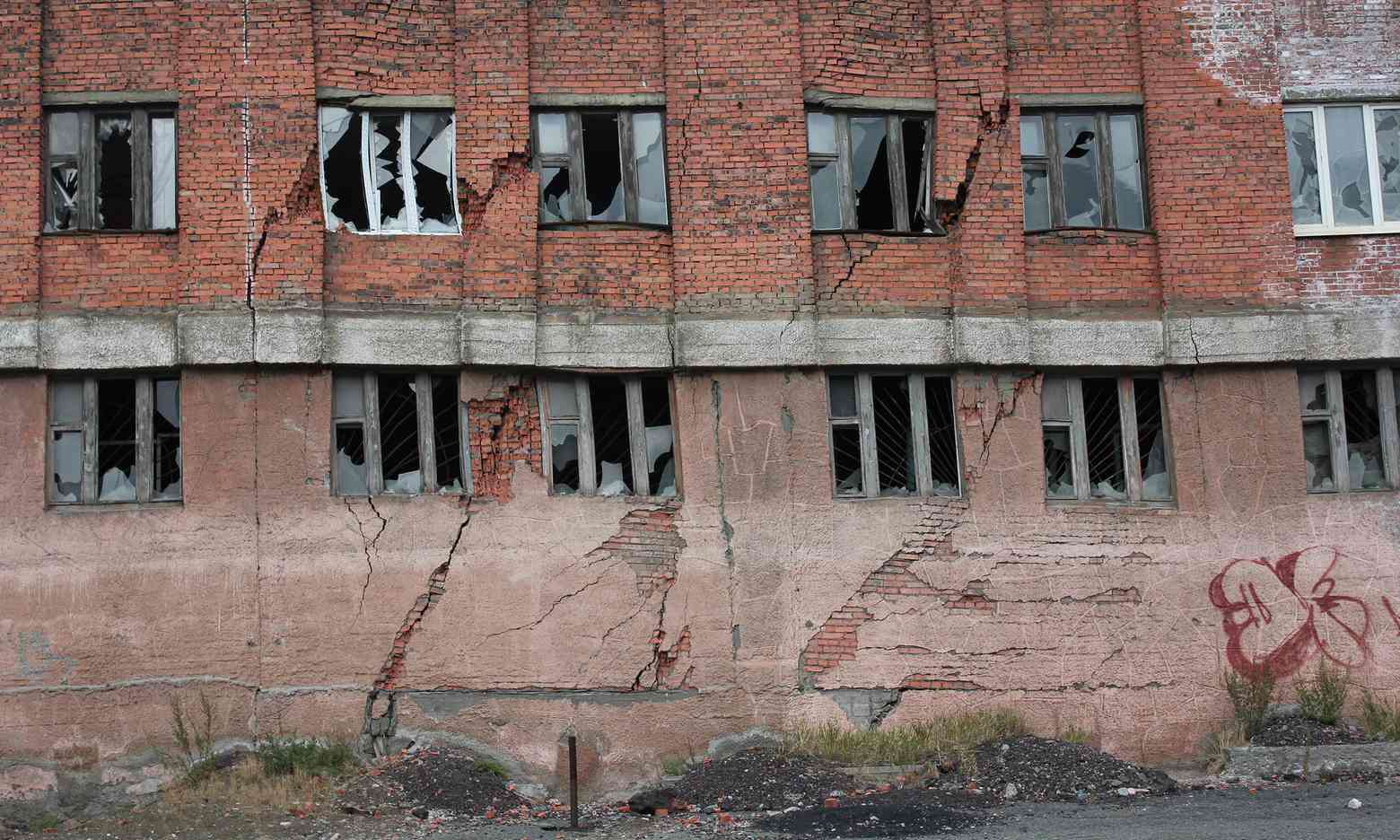
At first, Yury Scherbakov thought the cracks appearing in a wall he had installed in his two-room flat were caused by shoddy workmanship. But then other walls started cracking, and then the floor started to incline. “We sat on the couch and could feel it tilt,” says his wife, Nadezhda, as they carry furniture out of the flat.
Yury wasn’t a poor craftsman, and Nadezhda wasn’t crazy: one corner of their five-storey building at 59 Talnakhskaya Street in the northern Russian city of Norilsk was sinking as the permafrost underneath it thawed and the foundation slowly disintegrated. In March 2015, local authorities posted notices in the stairwells that the building was condemned.
Cracking and collapsing structures are a growing problem in cities like Norilsk – a nickel-producing centre of 177,000 people located 180 miles above the Arctic Circle – as climate change thaws the perennially frozen soil and increases precipitation. Valery Tereshkov, deputy head of the emergencies ministry in the Krasnoyarsk region, wrote in an article this year that almost 60% of all buildings in Norilsk have been deformed as a result of climate change shrinking the permafrost zone. Local engineers said more than 100 residential buildings, or one-tenth of the housing fund, have been vacated here due to damage from thawing permafrost.
 Alec Luhn