Inside the Bold Geoengineering Work to Refreeze the Arctic’s Disappearing Ice

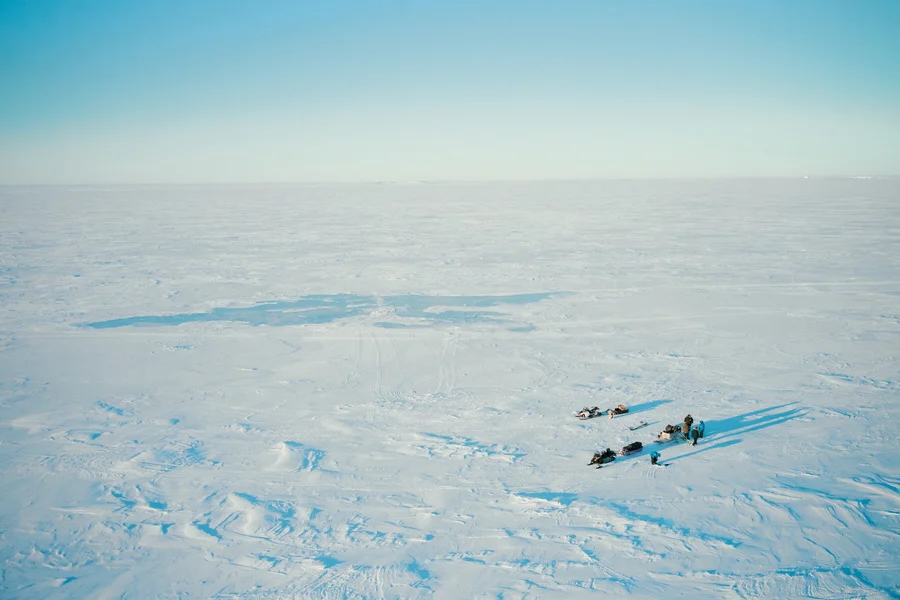
A haze of ice crystals in the air created a halo around the low sun as three snowmobiles thundered onto the sea ice on a February morning in far northern Canada. Wisps of snow blew across the white expanse. It was –26 degrees Celsius as we left Cambridge Bay, an Inuit village in a vast archipelago of treeless islands and ice-choked channels. This temperature was relatively warm—six degrees C above average. The winter had been the mildest in 75 years. The sea ice covering the Arctic Ocean was at its smallest extent on record. Scientists predict that within the next 15 years this ice cap will disappear in summer for the first time in millennia, accelerating global warming. The U.K. company Real Ice, whose heavily bundled team was bouncing around on the other two snowmobiles ahead of mine, hopes to prevent that outcome with an effort that has been called extremely ambitious, insane or even dangerous.

Read on at Scientific American

Listen to podcast at Science Quickly

Engineers are building the first bridge over a moving rock glacier

A grizzly bear explodes out of the shadowy brush in front of me and bounds up the mountainside, pausing to look back for one soul-shaking moment before continuing over the sunlit ridge with her two cubs.

Polychrome Pass in Denali National Park, Alaska, is full of such sublime sights. Streams the colour of pencil lead crash down from rapidly disappearing glaciers into the green tundra. Golden eagles glide over vast mountains of pink, brown and yellow volcanic rock. Far to the west, clouds swirl around the 6200-metre summit of Denali, North America’s highest peak.

Visitors used to take in these sights via a gravel road cut into the steep slope 120 metres above the valley floor, a route so dizzying that some would leave the bus and walk. Then in 2014, a section of the road the length of a football pitch started collapsing down the mountainside.

“It was dropping several feet a year,” says Brad Ebel, a former maintenance crew leader. “It was obvious that it was speeding up.”

Read on at New Scientist

Why East Antarctica is a ‘sleeping giant’ of sea level rise

Jan Lieser had just started going through the dozens of satellite images he looks at every day when he realised something was missing. As a glaciologist at the University of Tasmania’s Institute for Marine and Antarctic Studies, he knew the shape of every ice shelf sticking out from the coast of East Antarctica. And on 17 March 2022, there was a gap where most of the Conger glacier’s ice shelf had broken off into an iceberg the size of Vienna and drifted away.

Lieser was stunned. He had been keeping an eye on Conger since the last few pieces of the neighbouring Glenzer ice shelf had broken up 10 days before, but he had not expected to see it disintegrate so quickly. “All of a sudden the rest of the land-fast ice collapsed, and the ice shelf moved northward and turned 90 degrees sideways. Two features we had been monitoring for years weren’t there anymore,” he says. “In my 15 years of looking at it, I have not expected to see that in East Antarctica.”

Read on at BBC Future