Thawing Siberian permafrost soil risks rise of anthrax and prehistoric diseases

When authorities in Yakutsk invited participants in a youth government initiative to brainstorm ideas for an empty lot in the centre last year, it seemed like a smart way to get rid of an eyesore.

But the project was held up after residents and officials raised concerns that the site could hold anthrax spores preserved in the permanently frozen soil.

Although specialists eventually said it was safe to build a skate park on the lot, which once held a laboratory making an anthrax serum, the incident raised further questions about the ancient diseases known to be lurking in the permafrost—and whether they could be unlocked by global warming.

“Anthrax spores can stay alive in the permafrost for up to 2,500 years. That’s scary given the thawing of animal burial grounds from the 19th century,” said Boris Kershengolts, a Yakutsk biologist who studies northern climates. “When they are taken out of the permafrost and put into our temperatures, they revive.” Continue reading

‘He was a good kid’: Skripal poisoning suspect chose Russian army career after a childhood around soldiers

The man accused of poisoning Sergei Skripal grew up in a family with ties to the Russian army and signed up for officer training straight out of school, according to neighbours from his home town near the Chinese border.

Anatoly Chepiga,  who neighbours confirmed is the true identity of one of the alleged Salisbury nerve agent attackers, was raised in a single-storey white-brick house with a corrugated iron roof directly across a dirt road from the high school where he was a star footballer.

With three bedrooms, central heating and indoor plumbing, it was an affluent residence for the remote village of Berezovka, where many residents live in traditional stove-heated wooden cottages to this day.

But for neighbours here, the special forces colonel wanted by Britain for a nerve agent attack is fondly remembered as a conscientious student and keen sportsman whose glittering military career made his family proud.

“Yes, that’s him. I was friends with his father. He was a good kid,” Anatoly Chepaikin said on Friday when shown photographs of the man British authorities named as “Ruslan Boshirov.” Continue reading

Ballot boxes flown to herders at ‘end of world’ as Putin hunts down votes

As the electoral commission members rushed to set up the ballot box and voting booth in the deerskin tent, the lashing rotors of the helicopter outside reminded them that time was ticking.

“Are we re-electing Putin?” a reindeer herder asked as he lifted the flap and came in, every body part but his face bundled up in hides against the -28C (-18F) cold.

The three Nenets families at this windswept camp near the Arctic Circle in Siberia belong to one of the few nomadic peoples left in the world, travelling hundreds of miles in an annual migration to provide their reindeer with fresh pasture.

Sixty miles from the nearest city, the electoral commission essentially recreated a polling station in their tent before Sunday’s presidential election, in which Vladimir Putin is expected to win a fourth term in a landslide.

Within minutes, the ballots were cast, and the voting party began fighting its way back toward the Mi-8 helicopter through knee-deep snow and the downwash from the rotors. Then it was on to the next camp. Continue reading

Inside Russia’s ‘troll factory’: The Internet Research Agency accused of interfering in the US election

In 2015, Marat Burkhardt decided to try out for a better-paid position, writing in English rather than Russian, at the St Petersburg-based internet company where he worked.

The topic he was given for his 30-minute English writing test hinted at what kind of work his employer’s  “American department” would be doing over the next 12 months.

“It was a text prompt to write about Hillary Clinton’s chances in the presidential election in the United States,” he told The Telegraph. “I wrote that it would be great if the United States elected a woman for the first time. I said she has every chance, the Democratic Party is behind her. The choice is up to the American people.”

Unsurprisingly, he didn’t get the job: Mr Burkhardt’s employer, the Internet Research Agency, is believed to have been the engine of a secret Kremlin campaign to help Donald Trump win the election.

The full scale of alleged Russian election meddling was revealed on Friday as 13 people who worked for the Internet Research Agency were charged and their alleged crimes recounted in remarkable detail.

Continue reading

Violence and terrorism cast shadow over the slopes of Chechnya’s £80m ski resort

Ramzan Kadyrov, head of Russia’s restive Chechnya republic, doesn’t actually ski. So after he pulled a giant lever to start the chairlift at the new Veduchi resort on Friday, he rode it down to speak with the young men who had skied the resort’s only slope holding flags emblazoned with the faces of the strongman leader and his late father.

On the way back up, the chairlift briefly ground to a halt, leaving Mr Kadyrov, who enjoys near absolute power in Chechnya, dangling in the fog for several long seconds.

Nonetheless, he later promised guests including Russian Olympic athletes that a tourist hub with “ideal conditions” was being created here.

“I’m confident that it will become popular not just with the Russian population but also with foreign countries,” said Mr Kadyrov before jogging from the stage to a VIP area surrounded by bearded bodyguards.

But technical hiccups are hardly the biggest worries facing the ski resort, which is located 12 miles up the road from Shatoy, the site of a major battle with Chechen separatists in 2000.

Continue reading

‘Insurance’ against death: Russian cryonics firm plans Swiss lab for people in pursuit of eternal life

In a snowy village of run-down cottages outside Moscow, a pair of vacuum-sealed fibre-glass and resin tanks in a shed are taking 30 human bodies and 25 heads and brains on a journey into an eternal future.

It was two degrees below freezing on a recent afternoon on the outskirts of the ancient city of Sergiev Posad, but inside the two “cryostats” of liquid nitrogen it was much colder, -196C to be exact.

There a crew of intrepid “cryopatients,” who before their deaths were citizens of Russia, the United States, Japan, Australia, and several European countries, will be kept frozen until humanity figures out how they can be “revived and satisfactorily cured”. That’s according to KrioRus, the only company outside the United States engaged in cryonics, the low-temperature preservation of humans and animals for future resurrection. 

The ultimate goal is eternal life.

Continue reading

‘Like prisoners of war’: North Korean labour behind Russia 2018 World Cup

4932-2

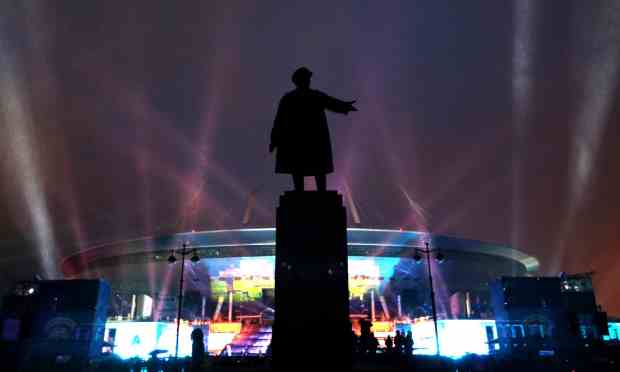
A test opening of St Petersburg’s Zenit Arena in February treated 10,000 spectators to car racing, motorcycle tricks, dancers and a performing bear introduced as “Russia’s greatest hero”. But the patriotic ceremony failed to note that the stadium, in which Russia kick off the Confederations Cup in a fortnight in preparation for next year’s World Cup, was built mostly by immigrant workers from Asia, including from one of the world’s most repressive countries, North Korea.

A subcontractor who asked to remain anonymous said at least 190 “downtrodden” North Koreans had worked long hours with no days off between August and November last year and that one, a 47-year-old, had died on site. “These guys are afraid to speak to people. They don’t look at anyone. They’re like prisoners of war,” the subcontractor said.

An employee of a North Korean state company that brings workers to Russia told the Observer at a St Petersburg construction site that the men often worked long hours and had to give part of their pay to the regime in Pyongyang to “facilitate the country’s defence”, which includes its nuclear weapons programme.

Read on at the Guardian

The reindeer herder struggling to take on oil excavators in Siberia

4932

Sergei Kechimov, an indigenous Khanty reindeer herder, lives in a one-room cabin with no running water more than 20 miles from the nearest village in Western Siberia. But his home is not as silent as you might think.

Across the swampy woodlands the beeping and rumbling of excavators are audible as they search for oil to prop up Russia’s slumping economy. Environmental protection for indigenous lands has recently been abandoned.

Kechimov, who has been appointed by his community as the guardian of holy Lake Imlor, remembers the lakes and rivers being so packed with fish that he could catch them by hand, but he believes that oil drilling has severely damaged the ecosystem.

The compensation the regional oil giant Surgutneftegas gives to the reindeer herders can’t make up for the harm done to their traditional way of life, he said. “They poison us with this filth and trick us.”

Read on at the Guardian

Russia’s rare snow leopards find protection in camera traps

2262

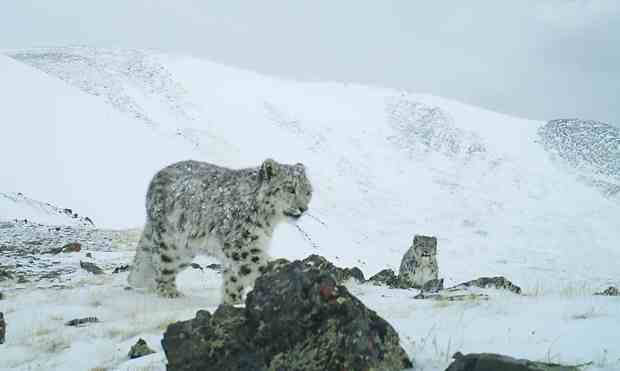
The snow leopard is so rare and elusive that it’s commonly known as the “ghost of the mountains”. But researchers in the Altai mountains, where the borders of Russia, Mongolia, Kazakhstan and China converge, are increasingly coming face to face with this endangered animal through a growing network of camera traps.

On a recent day in Sailyugem national park in Russia’s Altai Republic, rangers in ski goggles and huge parkas were retrieving footage from a high-altitude camera trap – a black box holding a dozen AA batteries, a memory card and a motion-activated lens – nestled among a cluster of dark burgundy rocks covered with orange and green lichen. Such windswept ridges are where snow leopards typically travel in search of prey such as ibex and musk deer, sneaking down from above to break the victim’s neck with one crunch of their powerful jaws.

“When camera traps appeared recently it was a huge boost because scientists got their hands not just on footprints but on photographs of the leopard itself, so we can identify individuals and their area of distribution,” said the park’s assistant director, Denis Malikov.

Russia Wants North Korea’s Money, Not Its Refugees

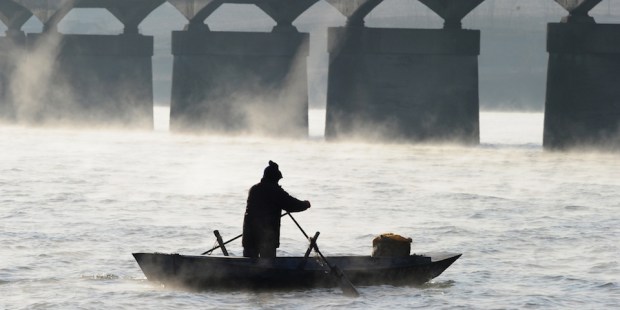
Steam rises off the freezing water as a

MOSCOW, Russia — A stocky 39-year-old Korean man in a white sweater with a snowflake pattern bustled around the kitchen, adding vinegar to a seaweed salad and spices to a pot of soup. He bowed and shook hands with everyone who entered, smiling and repeating “Hello!” and “Thank you!” in broken Russian.

It was the last night in Moscow for “Kim” — a pseudonym he uses to avoid retaliation against the relatives he left behind in North Korea — and the end of a saga that began during his native country’s great famine in the 1990s in which millions of his compatriots starved to death. Kim fled not once but twice. The first time he tried to defect, he made it to China, but was sent to one of Kim Jong Un’s infamous labor camps. The typical sentence for a defector was 10 years, essentially a death sentence, given that it meant 18 hours of hard labor a day, on three spoonfuls of rice each meal. But he managed to escape, this time to Russia, where his life became a constant struggle to avoid again being deported, to an almost certain death …

But there are many other North Koreans in Russia, and few are likely to be as lucky as Kim. As political and economic ties have improved in recent years between Moscow and Pyongyang, the two neighbors have signed treaties promising to repatriate criminals and all those “who have illegally entered and are illegally located” in each other’s countries.

Read on at Foreign Policy