Inside the Bold Geoengineering Work to Refreeze the Arctic’s Disappearing Ice

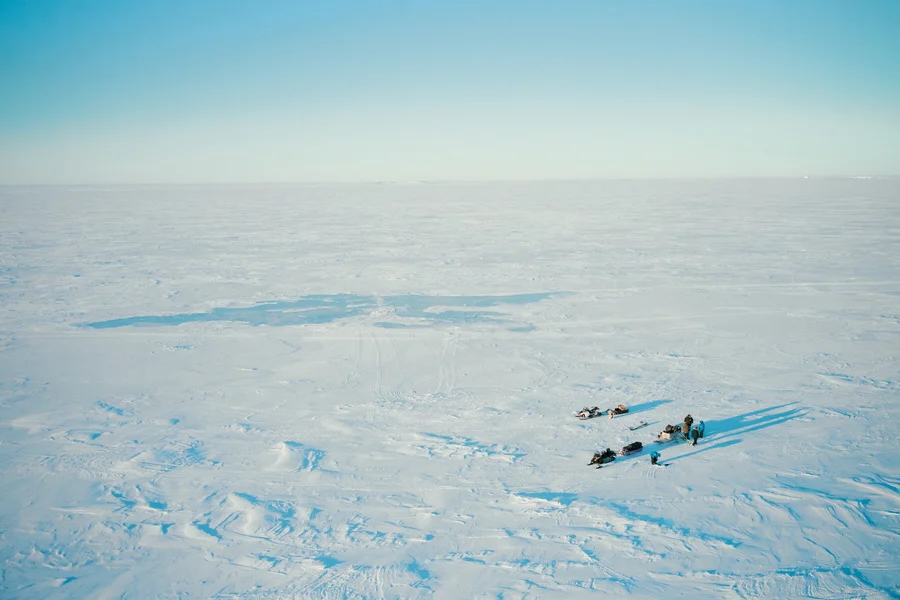
A haze of ice crystals in the air created a halo around the low sun as three snowmobiles thundered onto the sea ice on a February morning in far northern Canada. Wisps of snow blew across the white expanse. It was –26 degrees Celsius as we left Cambridge Bay, an Inuit village in a vast archipelago of treeless islands and ice-choked channels. This temperature was relatively warm—six degrees C above average. The winter had been the mildest in 75 years. The sea ice covering the Arctic Ocean was at its smallest extent on record. Scientists predict that within the next 15 years this ice cap will disappear in summer for the first time in millennia, accelerating global warming. The U.K. company Real Ice, whose heavily bundled team was bouncing around on the other two snowmobiles ahead of mine, hopes to prevent that outcome with an effort that has been called extremely ambitious, insane or even dangerous.
Read on at Scientific American

Listen to podcast at Science Quickly

Can Pulling Carbon from Thin Air Slow Climate Change?

One evening in late 1997, 11-year-old Claire Lackner walked into her dad’s study looking for an idea for an experiment for her sixth-grade science class. Her dad, Klaus Lackner, happened to be a physicist working on nuclear fusion at Los Alamos National Laboratory. He’d grown skeptical that fusion could replace dirty fuels and had started thinking about how to take greenhouse gases out of the atmosphere instead. So he suggested Claire try to capture carbon dioxide from air. She bought an aquarium pump and bubbled air through a test tube of sodium carbonate, a base, which bonded with the acidic CO2 in the airstream, removing about 10 percent of it overnight. Claire won a prize at the county science fair, and her father later wrote a paper arguing that extracting CO2 from air “has a reasonable probability of success” at reducing global warming.

Scientists had known since the 1950s how to strip CO2 from the air inside submarines and spaceships to keep the crews from suffocating. But Lackner’s paper was the first to argue that we could strip it from the atmosphere to keep Spaceship Earth livable. Claire’s experiment, he says, showed “it’s not all that hard.”

Read on at Scientific American

Why Are Alaska’s Rivers Turning Orange?

It was a cloudy July afternoon in Alaska’s Kobuk Valley National Park, part of the biggest stretch of protected wilderness in the U.S. We were 95 kilometers (60 miles) from the nearest village and 400 kilometers from the road system. Nature doesn’t get any more unspoiled. But the stream flowing past our feet looked polluted. The streambed was orange, as if the rocks had been stained with carrot juice. The surface glistened with a gasolinelike rainbow sheen. “This is bad stuff,” said Patrick Sullivan, an ecologist at the University of Alaska Anchorage.

Sullivan, a short, bearded man with a Glock pistol strapped to his chest for protection against Grizzly Bears, was looking at the screen of a sensor he had dipped into the water. He read measurements from the screen to Roman Dial, a biology and mathematics professor at Alaska Pacific University. Dissolved oxygen was extremely low, and the pH was 6.4, about 100 times more acidic than the somewhat alkaline river into which the stream was flowing. The electrical conductivity, an indicator of dissolved metals or minerals, was closer to that of industrial wastewater than the average mountain stream. “Don’t drink this water,” Sullivan said.

Read on at Scientific American

Engineers are building the first bridge over a moving rock glacier

A grizzly bear explodes out of the shadowy brush in front of me and bounds up the mountainside, pausing to look back for one soul-shaking moment before continuing over the sunlit ridge with her two cubs.

Polychrome Pass in Denali National Park, Alaska, is full of such sublime sights. Streams the colour of pencil lead crash down from rapidly disappearing glaciers into the green tundra. Golden eagles glide over vast mountains of pink, brown and yellow volcanic rock. Far to the west, clouds swirl around the 6200-metre summit of Denali, North America’s highest peak.

Visitors used to take in these sights via a gravel road cut into the steep slope 120 metres above the valley floor, a route so dizzying that some would leave the bus and walk. Then in 2014, a section of the road the length of a football pitch started collapsing down the mountainside.

“It was dropping several feet a year,” says Brad Ebel, a former maintenance crew leader. “It was obvious that it was speeding up.”

Read on at New Scientist

Why East Antarctica is a ‘sleeping giant’ of sea level rise

Jan Lieser had just started going through the dozens of satellite images he looks at every day when he realised something was missing. As a glaciologist at the University of Tasmania’s Institute for Marine and Antarctic Studies, he knew the shape of every ice shelf sticking out from the coast of East Antarctica. And on 17 March 2022, there was a gap where most of the Conger glacier’s ice shelf had broken off into an iceberg the size of Vienna and drifted away.

Lieser was stunned. He had been keeping an eye on Conger since the last few pieces of the neighbouring Glenzer ice shelf had broken up 10 days before, but he had not expected to see it disintegrate so quickly. “All of a sudden the rest of the land-fast ice collapsed, and the ice shelf moved northward and turned 90 degrees sideways. Two features we had been monitoring for years weren’t there anymore,” he says. “In my 15 years of looking at it, I have not expected to see that in East Antarctica.”

Read on at BBC Future

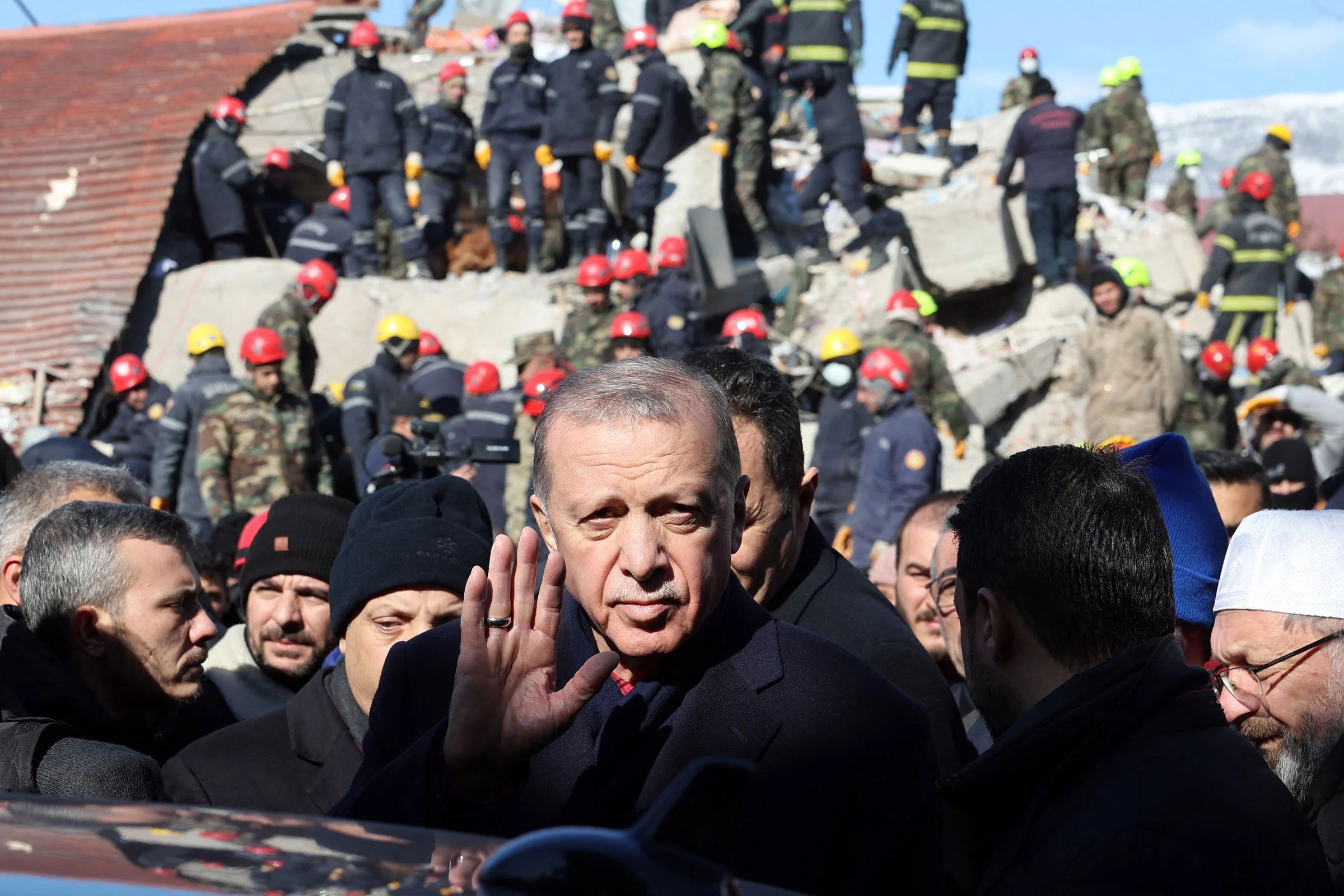
How Erdoğan’s Grip on Power Made Turkey’s Earthquakes Worse

When Ali Nusret Berker started seeing Twitter videos posted by people trapped under the rubble of the two Feb. 6 earthquakes in southern Turkey, they brought to mind the cousin he had lost when a massive earthquake hit his hometown near Istanbul in 1999. An avid cave explorer who just passed an exam to become an ambulance driver, the 33-year-old decided to go straight to the Yalova headquarters of AFAD, Turkey’s Disaster and Emergency Management Authority, where he was a search-and-rescue volunteer.

“I couldn’t sit in my warm home when they were screaming for help,” he tells TIME.

But sit at home is exactly what AFAD told Berker to do. He had to come back the next day to badger officials to send him and other volunteers south on an overnight bus ride to Iskenderun. There, AFAD employees tried to keep Berker and his ad hoc team from going to the hard-hit city of Samandag, he says. But the team caught a lift with a local man and eventually pulled five people out alive with a jackhammer, generator, and bolt cutter, which also had to be provided by residents. At least 800 people have died in the city.

“If we had equipment and if we reached Samandag quicker, we could have easily saved more,” Berker says. “There were so many voices that we couldn’t count. But after hours and hours the voices were going mute.”

Read on at TIME

Backcountry skiing sees resurgence – and the deadliest week for avalanches since 1910

There was no warning from the snow: no thump as it broke, no roaring as it gained speed, no shaking like an earthquake as it rushed toward the bottom. Maurice Kervin, 25, just noticed a huge crack had appeared beneath his snowboard and shot like a silent lighting bolt down No Name Peak in the Colorado Rockies. As he turned to look uphill, he was hit by a cascade of white that confirmed his worst fears. He was caught in an avalanche.

“A huge slab starts breaking out below me,” Kervin said. “Right at that moment it was like, we’re in it to win it now.”

It’s a story that has been all too common in the western United States this year, with more than 700 avalanches reported in Colorado in February. Many have even been captured on film, like a billowing torrent of snow that briefly buried three snowmobilers in a valley in Utah’s Uinta Mountains.

In February, 15 people died in seven days, the deadliest week for avalanches since 1910, when a 14ft wall of snow swept two stranded trains into a gorge in Washington and killed 96.

The number of fatalities has only continued to grow. Midway through the season, 33 people have been killed in avalanches, already surpassing the annual average of 26.

Read on at the Guardian